Introduction: Modernizing Account Receivables
When it comes to cash flow efficiency, insurance finance teams are often playing catch-up. Between chasing late premiums and navigating manual, line-by-line carrier reconciliations, routine billing can take up nearly 40% of an accounting department’s time according to industry estimates.
Modern insurtech solutions have moved far past basic “pay now” payment gateways. The real goal is establishing a purpose-built financial engine that seamlessly aligns with insurance-specific workflows, agency management systems, and trust accounting rules.
Two names that frequently surface for organizations looking to modernize their accounts receivable: ePayPolicy and InvoiceCloud®1. While both platforms offer secure, cloud-based electronic payment processing, they approach the market from fundamentally different angles.
Here is a balanced comparison of how they stack up across key categories.
The Generalist vs. Specialist
The primary difference between these two platforms lies in their target audiences and market focus.
- InvoiceCloud is a multi-industry platform. It’s utilized in sectors requiring high-volume billing and consumer self-service, such as local government municipalities, utility companies, consumer finance, and healthcare. The platform is designed to drive consumer enrollment in paperless billing and automated recurring payments.
- ePayPolicy is an insurance-specific payments platform built exclusively for the insurance industry. While it offers automated invoicing and recurring payment capabilities similar to InvoiceCloud, its entire ecosystem is tailored to the distinct workflows of independent agencies, Managing General Agents (MGAs), wholesale brokers, and insurance carriers.
Feature Set & Customer Experience
Both platforms excel at reducing administrative obstacles, but they do so by focusing on different user behaviors.
InvoiceCloud: Omnichannel Engagement
InvoiceCloud focuses heavily on the consumer payment experience. It contains a wide array of payment channels, including web portals, mobile apps, Text-to-Pay, Interactive Voice Response (IVR) phone systems, and physical kiosk support. For organizations dealing with the general public at scale, this omnichannel approach ensures maximum accessibility and higher on-time payment collection rates.
ePayPolicy: Insurance-Specific Workflows
Because ePayPolicy is built exclusively for insurance, its feature set addresses the unique operational realities of that sector. For example, it includes features like Finance Connect, which allows clients to view, e-sign, and integrate premium financing contracts directly at checkout. It also offers tools like CheckMate to handle the heavy volume of physical checks that still plague the insurance sector, automatically routing and reconciling them within the same digital dashboard with physical lockbox collection locations across the US.
Integrations and Implementation
A payment processor is only as good as its ability to talk to your existing core software.
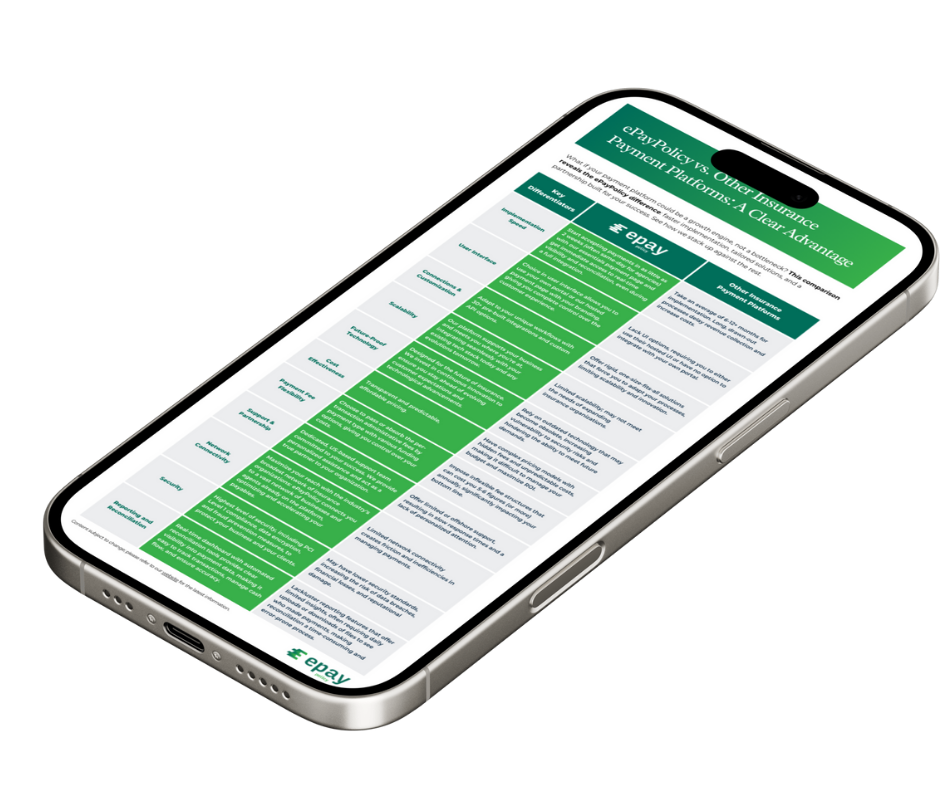
Feature | InvoiceCloud | ePayPolicy |
Primary Markets | Utilities, Government, Insurance, Finance | Insurance Agencies, MGAs, Carriers, PFCs |
Integration Capability | Deep Customer Information System (CIS) & ERP connections | Agnostic & Native Agency Management Systems (AMS) |
Implementation Speed | Typically requires a longer setup timeline due to complex IT integration. | Highly nimble; can go live in weeks |
Key Advantage | Drives higher digital adoption, and enables instant real-time claims payouts. | Accurate ledger balancing for complex insurance accounts while scaling across large enterprise workflows. |
InvoiceCloud integrates with major enterprise resource planning (ERP) platforms and Customer Information Systems (CIS). Because these systems are often complex, implementing InvoiceCloud can sometimes turn into a broader, multi-month enterprise software project requiring dedicated IT oversight.
ePayPolicy, by contrast, acts like a universal adapter for the insurance world. It features built-in, out-of-the-box integrations with the industry’s most popular Agency Management Systems (AMS) and accounting suites. Because it doesn’t try to fit the mold of other industries, the configuration is often much faster, allowing businesses to begin processing payments in a matter of weeks without getting dragged down in complex IT engineering.
Reconciliation and Settlement
From an accounting perspective, how funds are cleared and recorded matters immensely.
InvoiceCloud utilizes advanced reporting tools, including built-in AI report generators, to help finance teams analyze payment trends, track delinquency reductions, and manage transaction fee flexibility across broad consumer bases.
ePayPolicy’s backend is designed around the specific headache of insurance reconciliation—matching single lump-sum payments to complex, multi-line policy invoices, agency fees, and taxes. Financial leaders in the space frequently note its settlement speed and the precision with which it passes or absorbs processing fees without creating extra manual data entry for the escrow or accounting teams.
Horizontal Flexibility vs. Vertical Focus
Because InvoiceCloud is built horizontally, its platform is flexible enough to handle everything from municipal water bills to medical copays. However, this cross-industry framework might generic data fields over the specialized tracking elements insurance teams rely on. When a standard payment screen doesn’t require specific identifiers like a binder number or effective date, it frequently decouples the transaction from its policy details. When checkout interfaces do not capture insurance-specific identifiers (like policy numbers or effective dates) at the point of sale, accounting teams often have to perform additional manual research to align lump-sum payments with the correct policy.
ePayPolicy, on the other hand, is a vertically integrated platform built exclusively for the insurance ecosystem. Its check-out screens don’t just ask for generic dollar amounts; they can prompt clients for policy numbers, invoice references, or carrier details right at the point of sale. Because the payment and the policy data are locked together from the start, the funds route cleanly into the correct ledger. This potentially eliminates additional manual tracking from generalist processors and keeps your agency’s trust accounts flawlessly balanced without the extra backend friction.
Outbound B2B Payments vs. Broad Multi-Party Disbursements
Managing incoming cash is only half the battle; insurance accounting teams can spend an enormous amount of time sending money out.
- InvoiceCloud approaches outbound payments from an enterprise-wide perspective, offering Multi-Party Disbursements and commission routing. This is ideal for complex municipal legal refunds or broad consumer loan payouts, but it requires backend rules and manual workflow configurations to fit specific commercial agreements.
- ePayPolicy features a dedicated tool called Network Payables. This feature allows companies to initiate upstream carrier payments, co-broker commissions, and vendor refunds (individually or in bulk) directly from the payment dashboard. Because it operates within a verified network of insurance entities, funds route securely via ACH to other industry players with just a few clicks, bypassing slow, traditional check methods or manual wire transfers.
Final Thoughts: Which Should You Choose?
The decision between ePayPolicy and InvoiceCloud might ultimately come down to your operational landscape.
InvoiceCloud is engineered for high-volume operations and flexibility across multiple industries. If your organization manages direct-to-consumer policy portfolios, handles complex multi-pay schedules, or requires a wide net of policyholder payment channels, InvoiceCloud offers a robust, engagement-driven platform built to drive paperless adoption and lower billing call volume.
That said, for insurance organizations seeking a purpose-built payment network for premium receivables, payables, and automated reconciliation, a specialized platform offers distinct advantages. While a general platform can be configured to work, ePayPolicy inherently understands insurance mechanics out of the box. For teams looking to eliminate manual ledger reconciliation, sync directly with an AMS, and avoid a protracted IT setup phase, adopting a platform built by insurance professionals for insurance professionals frequently proves to be the smoother path to rapid ROI.
1 InvoiceCloud® is a registered trademark of Invoice Cloud, Inc. ePayPolicy is an independent entity and is not affiliated with, sponsored by, or endorsed by InvoiceCloud. All third-party trademarks belong to their respective owners.