In 2026, a check payment in insurance is more than an inefficiency; it’s a liability.
The manual effort of opening envelopes, matching checks to policy numbers, and chasing down insufficient funds notices is a drain on accounting and IT resources that could be better spent on activities that drive real growth.
Modernizing your payments isn’t just about giving clients an online payment link (but that helps!); it’s about choosing a payments partner that understands the specialized workflows of the insurance industry, and can connect to your existing technology stack.
Here’s a deep dive into the state of insurance payments today and how to choose the platform that fits your operational reality.
Hey – why does everyone hate paper checks?
The shift to digital payments in 2026 is driven by several factors:
- Customer Experience: Insureds expect the same checkout experience they get in retail. If a policyholder has to find a stamp to stay covered, they’re already looking for the exit. Insurance companies should be seeking any means of removing friction from binding a new or renewal policy.
- Reconciliation Challenges: Getting paid isn’t even half the battle. Manual accounting is the primary solution for many insurance companies, and it’s error prone. The cost of a misapplied payment (and the resulting E&O risk if a policy cancels) far outweighs the cost of a digital platform.
- Real-Time Data: Leadership needs to see cash flow in real-time, not in “whenever the mail arrives” time. Digital platforms provide an immediate snapshot of receivables that manual processes can’t match.
- Security Risk: We’ve beaten this topic to death, but it bears repeating. Check payments are slow, risky, and the most susceptible form of payment when it comes to theft and fraud. The average cost of a single instance of fraud? Over $15,000.
Considerations for Moving to Digital Payments for Insurance Companies
Before signing a contract, look under the hood. In my experience, these are the five areas of functionality you should pressure-test based on your workflows:
- Integration Depth: Does it actually talk to your accounting suite or Agency Management System (AMS)? If you have to manually enter payment data after the client pays online, you haven’t solved the problem. You just moved it further down the process chain.
- Fee Management: Fee flexibility is essential. Some companies elect to absorb credit card and ACH fees in order to increase digital adoption, but many elect to pass these fees. Your platform should handle the legal and technical heavy lifting of charging those fees to the insured.
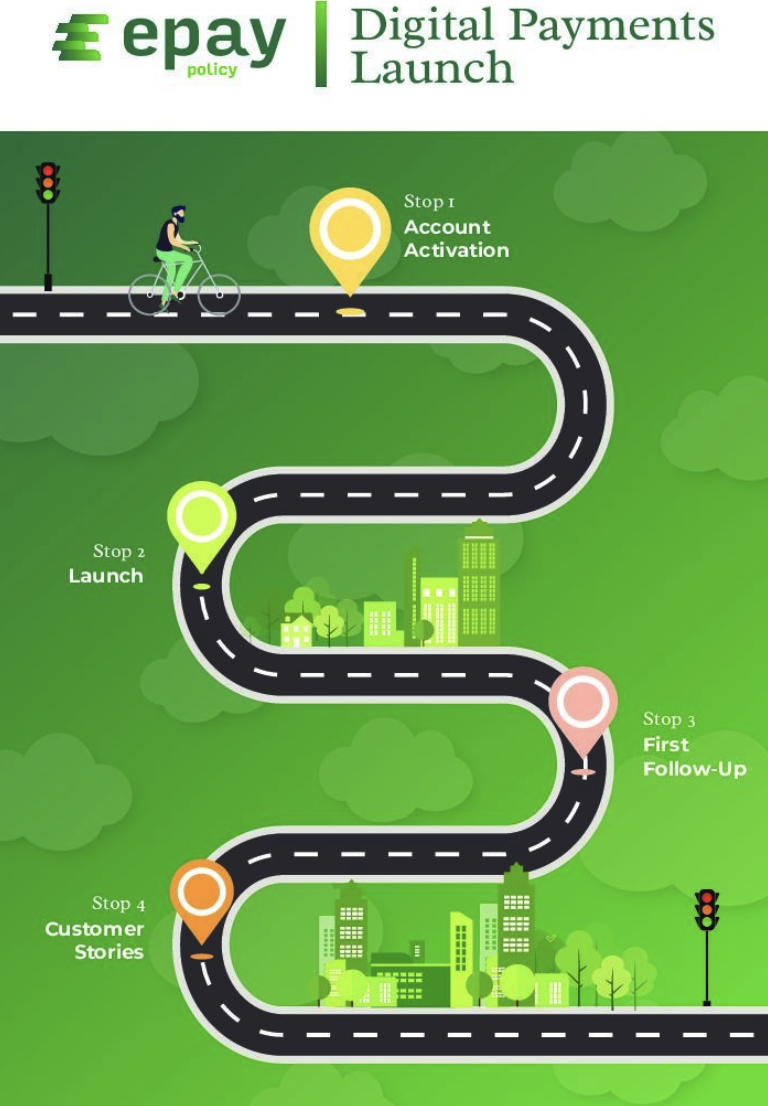
- Speed to Value: Some platforms take six months (or more) to launch. If you’re keen to launch faster than that, make sure your partner can keep up.
- Security (PCI Compliance): You want to get your team out of the business of handling credit card numbers. The platform should hold all the compliance risk.
- More Than Payments: Many insurance companies start with digital receivables, but leading companies that enjoy massive ROI on modernization don’t stop there. If your ambition is growth, look for a partner with other tools in the toolbelt to transform your accounting function, with additional enhancements in their roadmap for both AR and AP.
The 2026 Insurance Payments Lineup
Here is a quick look at the most well-known payments platforms in the insurance space:
- ePayPolicy: Built exclusively for insurance with high user sentiment. 12,000+ customers on the payments network including carriers, MGAs, agencies and premium finance companies (PFCs).
- OneInc: An enterprise giant that handles both premium collection and claims disbursements for major carriers.
- AppliedPay: A built-in option for those deeply embedded in the Applied Systems ecosystem.
- InvoiceCloud: A multi-industry, UX-focused platform that drives users toward automated payments and paperless billing.
- Simply Easier Payments: An agency-centric provider with simple UI/UX and easy onboarding.
- Input1: An option for those who want to merge traditional payments with a robust premium finance offering.
- Paymentus: An omnichannel platform (SMS, IVR, chat) designed for diverse payment methods. Not insurance-specific.
- AndDone (IPFS): A streamlined portal for those already using IPFS for their premium financing needs.
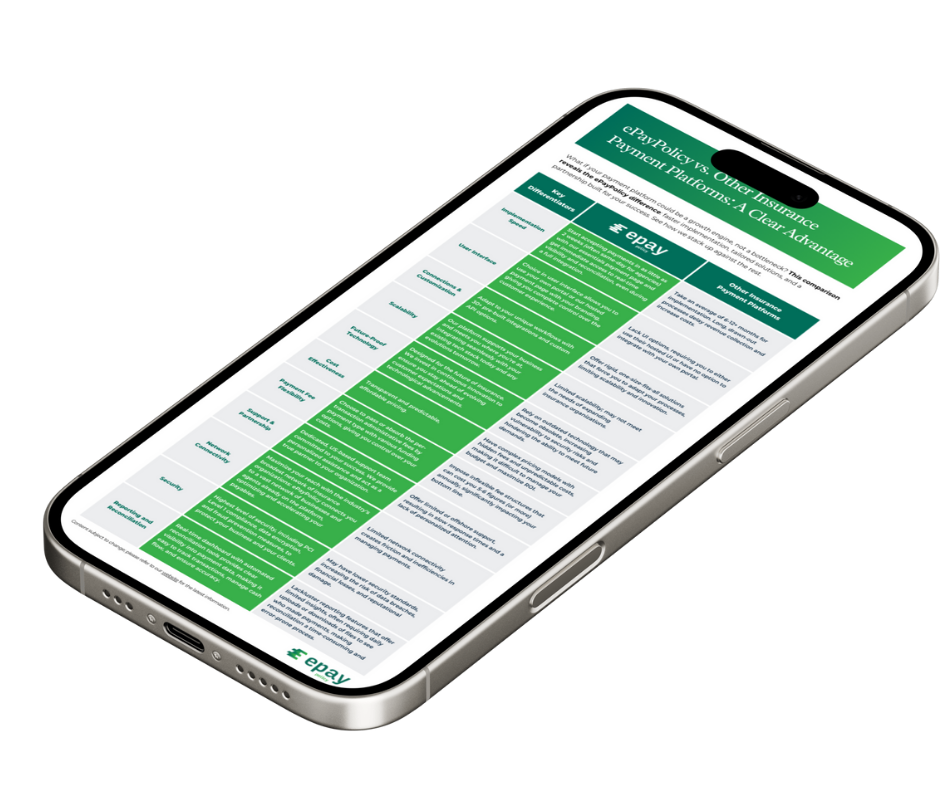
2026 Insurance Payment Platform Comparison
Platform | Best For | Review Avg (G2/Capterra) *June 2026 | Price (Reported Est.) | Key Features |
ePayPolicy | Agencies, MGAs, PFCs, Tier 3-6 Carriers | 4.9 / 5.0 | Monthly subscription, no contract options | AR/AP with AMS write-back, Fee Pass-through, Integrated Premium Financing |
AppliedPay | Applied Epic/TAM Users | 4.8 / 5.0 | Custom / Bundled | Native Epic integration, Premium Financing |
OneInc | Large Carriers | 4.2 / 5.0 | Enterprise SaaS | ClaimsPay (Disbursements), AR/AP suite |
InvoiceCloud | High-Volume Billing (Not insurance-specific) | 4.4 / 5.0 | Revenue Share / SaaS | “One-Click” Autopay |
Simply Easier Payments (SEP) | Small-medium sized agencies | 4.5 / 5.0 | Transaction + SaaS | E-signature + Pay integration |
Input1 | Premium Finance MGAs | 4.3 / 5.0 | Asset-based / SaaS | Integrated PFaaS, Multi-installment billing |
Paymentus | Omnichannel Enterprise (not insurance-specific) | 4.1 / 5.0 | Custom Enterprise | SMS/IVR/Chat payments, PayPal/Venmo |
AndDone (IPFS) | Agencies using IPFS | 4.0 / 5.0 | No SaaS Fee | Direct link to IPFS financing |
Head-to-Head: ePayPolicy vs. The Field
ePayPolicy vs. OneInc
For large carriers, OneInc has been the default choice for some time. It’s powerful, handles complex claims disbursements, and is built for their scale. However, for Tier 3-6 carriers, MGAs or large agencies, OneInc is often overkill. ePayPolicy offers a faster “time-to-value,” launching in days-weeks hours compared to OneInc’s multi-month implementation, making it a more nimble choice for firms that don’t need a massive claims disbursement engine.
ePayPolicy vs. AppliedPay
The two top options for agencies, according to the 2026 Catalyit State of Tech report. This is a common debate for Applied Epic users. AppliedPay is native, but ePayPolicy is AMS-agnostic, meaning if you ever move away from Applied, your payment infrastructure stays with you. Many finance leaders reportedly prefer ePayPolicy’s settlement speed. Lastly, ePayPolicy is more fully featured, having been in market years longer than Applied’s payment solution.
Deep Dive: Detailed Comparison Between ePayPolicy and Applied Pay >
ePayPolicy vs. InvoiceCloud
InvoiceCloud focuses heavily on getting customers to sign up for “Autopay” with excellent UX design cues. While their interface is sleek, the setup is often tailored to larger utility-style billing, as InvoiceCloud is not built exclusively for the insurance industry. ePayPolicy offers a straightforward, insurance-centric onboarding process that many accounting teams find easier to manage.
ePayPolicy vs. Simply Easier Payments
Simply Easier Payments is a solid, compliance-first tool, aimed mostly at smaller agencies. ePayPolicy offers similar compliance features with a much more modern SaaS feel. For an IT leader, ePayPolicy’s more robust APIs, integrations and modern documentation make it the easier choice for future-proofing your tech stack.
ePayPolicy vs. Input1
Input1 specializes in premium financing. If your business is 90% financed, Input1’s integrated platform is a strong contender. However, for the average agency that needs a mix of “Pay in Full” and standard installments, ePayPolicy provides a more versatile gateway that handles everyday credit card and ACH transactions with less operational friction. Additionally, ePayPolicy’s new Finance Connect feature allows you to offer premium financing at quote and checkout, by integrating your existing PFC partners.
ePayPolicy vs. Paymentus
Paymentus is for organizations that want to accept payments via every possible channel, from SMS to Facebook Messenger. While impressive, this omnichannel approach can miss the nuances of insurance workflows. ePayPolicy wins on merit for insurance because it focuses strictly on the specific needs of the insurance payments network, rather than trying to serve multiple industries.
ePayPolicy vs. AndDone (IPFS)
AndDone is a great entry point if you’re already a heavy IPFS user. As a newer entrant, AndDone’s platform is still adding many of the features and reporting that ePayPolicy has offered for years. Additionally, ePayPolicy offers advanced reconciliation tools and the ability to work with multiple premium finance partners, not just IPFS.
Wrap Up: The Case for Flexibility
When you weigh the actual merit of these platforms, ePayPolicy emerges as the most flexible choice for the majority of use cases. It manages to be simple enough for a local agency yet sophisticated enough for a large MGAs, Top 100 Agencies and Carriers.
While some competitors excel in niche areas—like OneInc for claims or Input1 for financing—ePayPolicy is the “universal adapter” of the insurance world. It offers the highest user satisfaction ratings for a reason: it solves the reconciliation problem without creating an implementation problem. For a leader looking to modernize with minimal operational investment, it is the most logical place to start.
For the leader tasked with “modernizing without the headache,” ePayPolicy remains the recommendation because it avoids the two biggest traps of this transition: IT over-complexity (OneInc/Paymentus) and Accounting manual-work (AndDone/basic portals). It is the only platform that consistently delivers a 4.9-star experience by focusing on the specific workflows of an insurance company’s daily workflow.
– Frequently Asked Questions –
Is ePayPolicy PCI Level 1 compliant, and why does the “Level” matter?
Yes, ePayPolicy is PCI Level 1 compliant, which is the highest and most stringent security standard in the payment industry. For an IT leader, this is critical because it means the platform undergoes annual third-party audits and rigorous penetration testing. Using a Level 1 provider drastically reduces your business’ PCI compliance scope and suit requirements.
How long does it take to implement ePayPolicy?
Insurance companies looking to get started with digital payments can often get started within 24-48 hours of underwriting approval. For large insurance companies requiring custom integration and development work, launching can take longer, but is often much shorter than monthslong implementation processes from other enterprise payments platforms like OneInc.
What is “AMS Write-back,” and how does it reduce accounting labor?
Write-back, or automated data reconciliation, can turbocharge insurance accounting operations. Instead of manually marking an invoice as “Paid” in your management system (like Applied Epic or Vertafore), the payment platform sends a secure signal to the AMS to automatically create the cash receipt and close the invoice. ePayPolicy’s merit here lies in these capabilities,, which matches payments to specific invoice numbers, potentially saving hours of manual data entry per week, while improving reporting accuracy.
How long does it take for funds to settle into our bank account?
While legacy paper checks take 10-14 days to fully clear and settle, digital platforms have shortened this significantly. Standard ACH through ePayPolicy typically settles in 2-3 business days. If you are using a platform with real-time rail integration (like OneInc for claims), disbursements can happen in seconds, though for premium collection, the 48-hour window remains the industry standard for risk management.
Is a “Zero-Fee” platform like AndDone actually free?
Not exactly. Free platforms usually operate on a transaction-only model where the cost is baked into a higher percentage fee for the insured or a specific margin on premium financing. While you save on the $25-$100 monthly SaaS fee, you may lose out on advanced reporting, multi-AMS integrations, or support. For most leaders, the cost of a manual reconciliation error far exceeds the small monthly subscription of a premium tool like ePayPolicy.
How can insurance companies drive customer adoption of the new payment portal?
It’s important to understand that user behavior often changes slowly without reinforcement. Modern platforms increase adoption through “Digital Nudges.” ePayPolicy and InvoiceCloud allow you to embed “Pay Now” links directly into email signatures and invoices. Adding links to your company website, integrating with your AMS tools for real-time invoicing and reminders and ongoing insured communications are all a part of a broader plan to migrate customers to online payments. Some providers have dedicated account managers to help guide you and provide resources for your insured payers and partners.
Citations & Sources:
- Gartner Digital Markets: 2026 Category Leaders in Payment Processing
- Capterra/G2 User Sentiment Index (Q1 2026)
- The Digital Edge Report: 2025/2026 Insurance Payment Adoption Trends
Catalyit: 2026 State of Tech Report