
1. Why General Payment Tools Fall Short in Insurance
For modern insurance organizations, whether you are an independent agency, a high-volume Managing General Agent (MGA), or a regional carrier, payment processing is never just about “getting a credit card number.” It is a foundational compliance, accounting, and workflow challenge. And it’s a task that many growing insurance companies would rather avoid. “I don’t want to be in the payments business” is a refrain we’ve heard repeatedly over the years.
Chasing down premium receivables, juggling physical paper checks, and executing manual line-by-line carrier statement reconciliations can swallow up to 40% of an accounting team’s operational bandwidth.
When looking to modernize, many companies look at household tech names like Stripe, Square or Paypal. It’s a hammer-meets-nail fix; you need to take a payment, and those tools do that with extreme simplicity.
While Stripe is a powerhouse for standard e-commerce, the unique regulatory, ledger, and fiduciary constraints of the insurance lifecycle require more than a generic checkout button. The real choice isn’t just about digital payments; it’s about whether you want to build a custom developer project or deploy a plug-and-play financial platform built for insurance.
2. Stripe & Generic Processors: The “All-Purpose” Infrastructure
Stripe is one of the world’s most successful horizontal payment processors. It provides robust developer APIs, checkout widgets, and global scale.
Core Architecture & Alignment
By default, Stripe treats every transaction identically. Whether a customer is buying a $15 streaming subscription or a $50,000 commercial property premium, the underlying architecture views it simply as a charge to a card or an ACH account. It is designed to deposit a net settlement (total payment minus processing fees) into a standard corporate checking account.
Key Value Drivers & Limitations
- Developer First: If you have an in-house team of software engineers, Stripe gives you control over building a bespoke front-end checkout experience.
- Massive Scale: It handles high volume effortlessly and supports global currencies..
- The Insurance Disconnect: Stripe has zero native awareness of what an invoice, policy binder, agency-bill, or direct-bill means. It does not speak the language of insurance, meaning you must build and maintain the logic yourself.
3. ePayPolicy Overview: Payments Built Just for Insurance
Founded by insurance industry specialists specifically to solve the “trust account dilemma,” ePayPolicy operates as an infrastructure-level financial layer for the entire insurance lifecycle. It serves over 12,000 carriers, agencies, MGAs, and premium finance companies.
Core Architecture & Alignment
Instead of forcing insurance companies to change their accounting rules to match standard retail software, ePayPolicy built its system around the industry’s existing frameworks. It functions as a connected platform that communicates with major industry software right out of the box, translating transaction data seamlessly into your general ledger and matching posted payments to their corresponding invoices and policies.
Key Value Drivers & Features
- Tech Stack Flexible: Because ePayPolicy is system-agnostic, it sits cleanly alongside your tools. If your organization changes management systems (AMS) or undergoes an M&A transition, your payment infrastructure, consumer portals, and accounting logic stay completely uninterrupted. Custom or bespoke accounting systems can be connected via API integrations, with a dedicated support team.
- Fiduciary Isolation: It isolates gross premium from processing fees at checkout, ensuring fiduciary compliance and protecting insurance trust accounts.
- Expanded Product Suite: Features like CheckMate® (a digital lockbox for insurance) and Network Payables expand usability past simple accounts receivable, automating outbound vendor and commission payments.
4. Deep-Dive Feature Comparison and Strategic Advantages
A. Trust Account Safeguards & Fee Compliance
In retail e-commerce, merchants simply absorb the 2-3% credit card processing fee as a cost of doing business. In insurance, co-mingling funds or paying transaction fees out of an escrow or trust account can trigger severe regulatory and compliance violations.
- With Stripe: By default, Stripe deducts its processing fee before depositing the money into your account. If an insured pays a $10,000 premium, Stripe might deposit $9,700. Your accounting team now has a $300 shortfall in your fiduciary account that must be manually tracked and covered. While Stripe allows you to pass surcharges, doing so in full compliance with localized state insurance regulations and card network rules often requires custom development.
- With ePayPolicy: The platform was built specifically for the convenience fee model. When an insured pays, ePayPolicy collects the transaction fee dynamically and entirely separately from the net premium. 100% of the premium lands cleanly in your trust account, completely avoiding shortfalls and eliminating manual journal entries. What’s more – ePayPolicy customers can choose to absorb or pass fees to the insured, potentially saving additional margin that otherwise would reduce commission or operational revenue.
B. AMS Workflow Integration vs. Custom API Coding
Remember the “hammer-meets-nail” example from earlier? One problem solved too quickly often begets another. In the case of insurance, reconciliation is where generic processors can create massive administrative headaches for accounting teams.
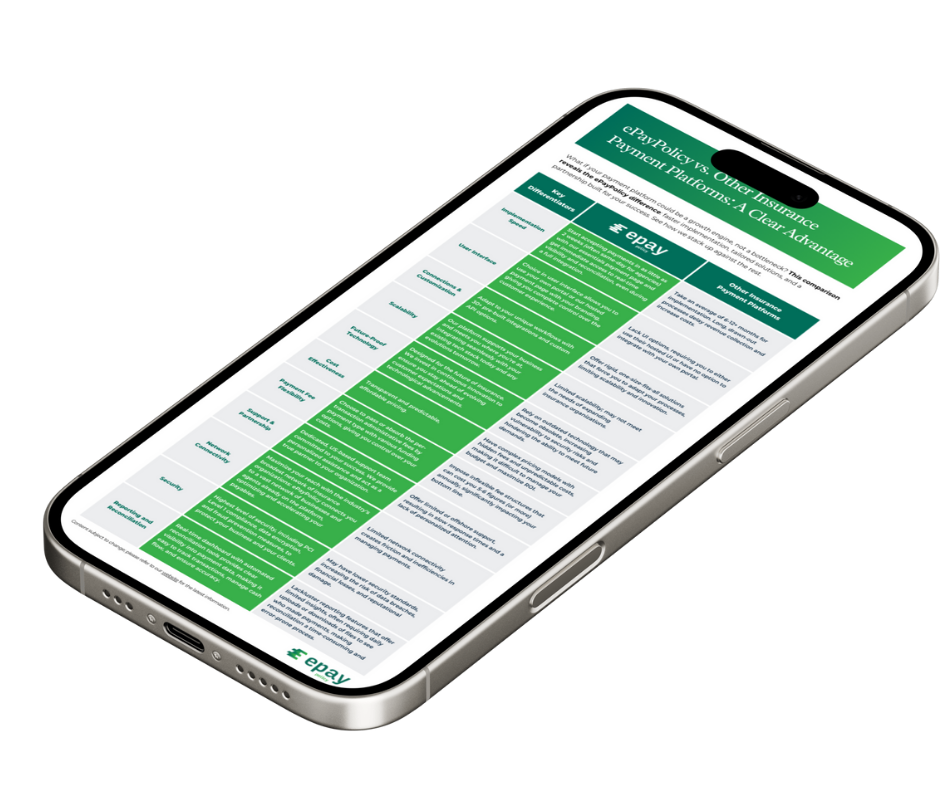
Capability | Generic Processors (Stripe) | ePayPolicy |
Primary Focus | General E-commerce / Tech Startups | Insurance Agencies, MGAs, Carriers |
AMS Integrations | None. Requires custom API development. | Native integration with Vertafore, Applied, HawkSoft, etc. |
Ledger Writebacks | Manual data entry or custom middleware needed. | Automated real-time posting back to exact open invoices. |
Premium Financing | Manual setup or integration via external apps. | Native Finance Connect integrated directly at checkout. |
Physical Checks | Requires separate bank lockbox or manual scanning. | Integrated CheckMate® network transforms paper checks to digital. |
C. Handling the Paper Check Reality
Even as digital adoption climbs, high-premium commercial lines still rely heavily on paper checks.
Stripe provides no answer for the physical paper check sitting on an account manager’s desk. ePayPolicy solves this with CheckMate®. Physical checks are routed to secure lockbox nodes, scanned, and uploaded to your unified dashboard. CheckMate can serve as a simple receivables collection point, integrated with your ePayPolicy dashboard, or can automatically match paper checks against open invoices in your management system.
5. Implementation, Stability, and Support Expert Overlap
If a payment loop fails, an automated checkout page breaks, or an ACH transaction bounces, you need immediate, contextual assistance.
- Stripe Support: Support is largely handled via automated documentation, chat bots, or tickets read by generalists. If you tell a Stripe representative that an “ACH bounce disrupted an agency-bill binder timeline,” they will likely look at it purely as a generic failed bank transfer.
- ePayPolicy Support: Onboarding and underwriting for opening an account typically clears within 24 to 48 hours. Support teams are entirely US-based insurance experts. When you call, you speak to an account specialist who actually understands the operational workflows of an insurance accounting department.
6. Closing Recommendation: Which is Best for Your Organization?
If you’re a massive enterprise insurtech company building a completely proprietary, consumer-facing software application from scratch and you possess a massive budget for in-house developers, Stripe provides an excellent, raw utility engine to build upon.
However, for traditional and scaling insurance organizations looking for immediate, compliant, and deeply integrated efficiency, ePayPolicy is the clear winner.
Choosing ePayPolicy guarantees that your transaction processes remain portable, secure, and legally insulated from trust account shortfalls. It supercharges operations across your existing staff, integrates out-of-the-box with your AMS system, and delivers specialized financial automation built explicitly for the landscape of modern insurance.
Going Deeper – How Different Insurance Segments Use ePayPolicy
Every insurance business handles premium collections differently. Whether you are an independent agent managing local personal lines or a tier-one carrier managing multi-state books of business, generic payment platforms start with a one-size-fits-all model. Here’s how ePayPolicy specifically addresses the distinct pain points across the entire insurance spectrum compared to generic processors like Stripe.
Small to Mid-Sized Agencies: Saving Margin and Time
For small to mid-sized independent agencies, operational efficiency and margin preservation are everything. Staff members typically wear multiple hats, often jumping from customer service to account manager to bookkeeper. When using a generic processor like Stripe, a small agency is forced to either absorb processing fees (eating into commissions) or try to build custom workflows to pass those fees along. Furthermore, someone might need to manually log into Stripe, verify the payment, and type that data into the agency management system (AMS) to update the client file.
ePayPolicy gives agencies automation without the enterprise price tag or IT overhead. Because the platform natively handles the convenience fee model out of the box, agencies can instantly stop losing money to credit card swipe fees while fully maintaining trust account compliance.
More importantly, pre-built integrations with standard agency management systems mean that when an insured pays their bill online, the transaction automatically updates the ledger. This frees up administrative staff to focus on binding new business and retaining clients rather than chasing down late payments, manually keying data and hunting down small bookkeeping errors.
Large Agencies & Aggregators: Portability and Multi-Location Accounting
Large, multi-location agencies, high-volume brokers, and fast-growing aggregators face severe operational friction when it comes to technology consolidation and merger and acquisition (M&A) activities. When a massive brokerage relies on a general payment processor like Stripe, their financial stack becomes heavily dependent on custom middleware, bespoke developer code, and fragile API pipelines built to connect their payment gates to their internal databases. If the agency decides to roll out a new core software platform, or if they acquire a firm that uses a different management system, that entire custom payment pipeline breaks. The accounting department is then buried under manual journal entries across disparate office locations.
ePayPolicy solves this infrastructure puzzle, because it is system-agnostic and plugs natively into virtually every major industry platform (including Vertafore, Applied, and HawkSoft), it acts as a universal financial layer. If a large broker acquires three agencies in a quarter, they can quickly deploy ePayPolicy payment portals across those new locations, route funds to distinct regional bank accounts, and keep corporate financial oversight completely unified. Or they can choose to consolidate payments with one payment link.
Your payment processing architecture, customer checkout experience, and compliance rules stay entirely unchanged no matter how much your underlying software tech stack evolves.
MGAs & Wholesalers: Complex Split-Pay Logic and Market Speed
Managing General Agents (MGAs) and wholesale brokers occupy a highly complex space in the insurance lifecycle, balancing the demands of retail agents on one side and carrier requirements on the other. Speed-to-market and accurate premium accounting are critical to keeping binders moving.
Generic systems like Stripe aren’t designed for the nuances of split payments, net-versus-gross premiums, and taxes/surcharges unique to excess and surplus (E&S) lines. Trying to program Stripe’s native routing tools to handle an MGA’s specific commission-splitting and fiduciary allocations requires significant logic building, and is not without technical risk.
ePayPolicy is built specifically for the multi-tiered nature of MGA accounting workflows. Through tools like Finance Connect and specialized invoicing features, an MGA can deliver quotes that embed premium financing options right at the point of purchase, automatically separating down payments and adjusting the backend ledger without manual math.
Furthermore, ePayPolicy’s Network Payables feature allows MGAs to easily execute outbound payments across their entire partner grid, automating carrier payments and retail commission distributions out of a single hub.
Carriers: Scale, Compliance Audits, and Fiduciary Isolation
At the carrier level, payment processing is a high-volume risk management exercise. When handling tens of millions of dollars in premium revenue across multiple state lines, statutory accounting rules and stringent compliance audits leave no room for error. A horizontal tool like Stripe is structurally built to bundle transaction fees and clear deposits in net settlements, a practice that heavily complicates a carrier’s regular accounting sweeps and internal financial audits.
Furthermore, generic processors lack the localized guardrails required to strictly enforce varying state department of insurance (DOI) regulations concerning convenience fees and surcharge structures.
Carriers utilize ePayPolicy as a hardened, corporate financial utility that respects strict fiduciary isolation. The platform keeps gross premium deposits completely insulated from operational transaction fees, providing clean, line-item auditable reporting that satisfies state regulators and internal compliance teams effortlessly.
Additionally, because high-premium commercial carriers still receive thousands of paper checks every month, ePayPolicy’s CheckMate® lockbox system bridges the digital divide. By automatically digitizing physical paper checks and using machine learning to match them against open carrier invoices, it slices back-office operational overhead by more than half, converting slow physical mail into immediate, cleared cash flow.
Frequently Asked Questions
- Is it legal to pass credit card processing fees to an insured? Yes, but it is highly regulated. Card brands (Visa/Mastercard) and individual state insurance commissioners have very specific, divergent laws regarding “surcharging” versus “convenience fees.” ePayPolicy’s systems are pre-configured to navigate these legal lines automatically based on your location and license type, whereas generic processors require you to research and code those legal guardrails yourself.
- Can we still absorb the fees if we want to? Absolutely. While many ePayPolicy customers pass payment fees by default, it fully supports an absorbed model where your organization pays the transaction costs, giving you total workflow flexibility based on your specific client types.
- What happens if we switch from one Agency Management System to another? If you use a generic payments provider, any custom-coded bridge you built to tie it into your old AMS likely completely breaks, forcing you to re-hire developers to write a brand new integration. With ePayPolicy, because the platform is system-agnostic, you simply disconnect your old AMS and connect the new one, with help from ePayPolicy’s dedicated Integrations team, if needed. Your client payment pages, portals, and transaction history remain tidy within your ePayPolicy dashboard.