
Manual payment collection and reconciliation are not a permanent fact of agency life. They are solvable process problems, and the fix rarely requires replacing a single system you already use.
Most independent insurance agency owners believe that the manual payment grind is simply how insurance operations work, rather than a process problem they can solve, because every agency around them operates the same way and no one has offered a credible alternative that fits inside their existing systems. That belief is wrong, and it’s costing them real money every week.
“Insurance claims processing takes weeks to months, and any resubmission or error extends that timeline significantly, highlighting the operational burden that workflow automation in the field aims to address. Insurance workflow automation is the targeted replacement of repetitive, rule-based tasks with software that runs those steps automatically, payment collection, document routing, renewal reminders, and reconciliation. Across the market, administrative overload and manual process bottlenecks span the full insurance lifecycle, and most of them can be addressed without replacing core systems at all. See our insurance billing software for how this works in practice.”

It does not mean ripping out your AMS, retraining your entire staff, or hiring a systems integrator. It means identifying the specific step where a human is doing something a rule could do, matching a payment to a policy, routing a document to the right folder, firing a renewal notice 30 days before expiration, and replacing that step with software. A targeted automation touches one workflow.
It goes live in days. Agencies that try to automate everything at once end up in exactly the IT-project territory they were trying to avoid. The smarter move is sequencing by pain. Payment collection and reconciliation sit at the top of that list for most independent agencies: high daily friction, low technical complexity, fast to fix. AI and OCR handle one job extremely well: reading documents so humans don’t have to.
Key takeaways
- Many independent agencies have a payment operations problem that feels like a daunting IT project, so it rarely gets addressed.
- Six workflows drive the majority of manual labor in a typical agency, but they have very different deployment timelines, some go live this week, others take quarters, and conflating them is why most automation initiatives stall before they start.
- Paper checks are not a legacy quirk; they’re an active cost center that most agency owners have stopped noticing because the losses don’t surface cleanly in any single report.
- Payment collection, reconciliation, and check processing are the highest-ROI entry points for automation, not claims, not FNOL, because they bleed time and margin every week with no visibility.
- Straight-through claims processing and automated renewal orchestration are independently deployable modules, not one tangled system, you don’t have to automate everything to get real operational leverage from any of them.
- Compliance documentation gaps only become visible when a regulator asks for records you have to reconstruct from memory, automated audit trails eliminate that exposure without requiring a new core system.
- ePayPolicy closes the payment loop directly: agencies can accept secure online payments with connected accounting that auto-reconciles, replacing the manual check-and-post cycle without touching existing agency management systems.
Key Insurance Workflows Ready for Automation – Starting With the Ones That Hurt Most
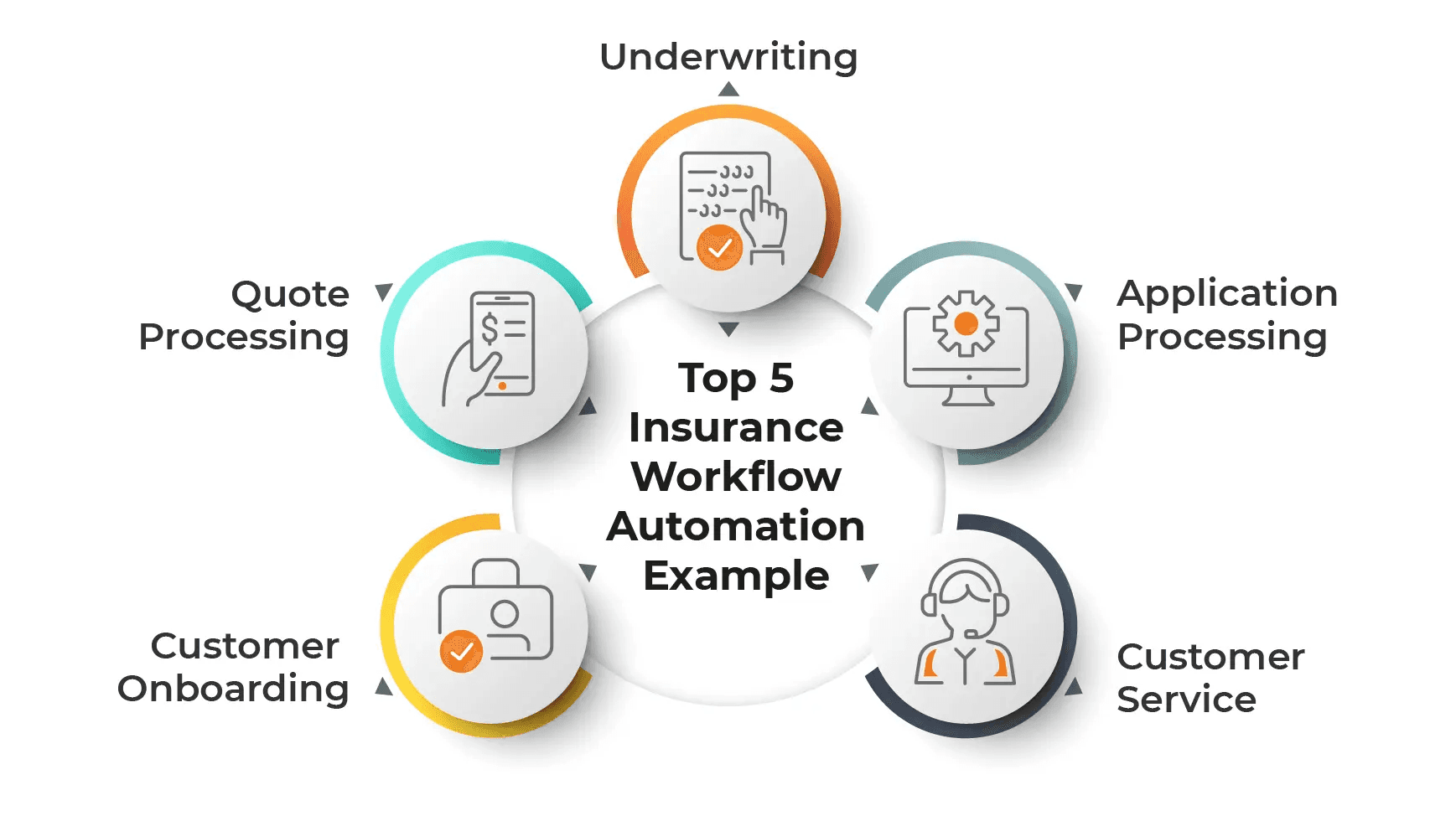
Six workflows account for the majority of manual labor inside a typical independent agency. The problem is that most agency owners treat them as a single, undifferentiated mass of “stuff that needs automating” rather than a ranked list with very different deployment realities. Some of these workflows can go live this week. Others will take quarters. Knowing which is which changes everything about where you start. Agencies still running manual, legacy workflows carry meaningfully higher operating costs compared to peers on modern systems with automated workflows, a gap that makes prioritization a financial necessity.
1. Claims Intake & First Notice of Loss (FNOL) Automation
FNOL is where delays hurt most, adjusters spend 40%+ of their day re-keying data from emails, PDFs, and phone notes into core systems. Insurance workflow automation at intake uses AI-powered document extraction to capture structured claim data instantly and route it to the right adjuster. The real tradeoff: complex liability claims still need human judgment at triage, so automation works best on high-volume, straightforward loss types.
2. Policy Renewal Outreach & Expiration Tracking
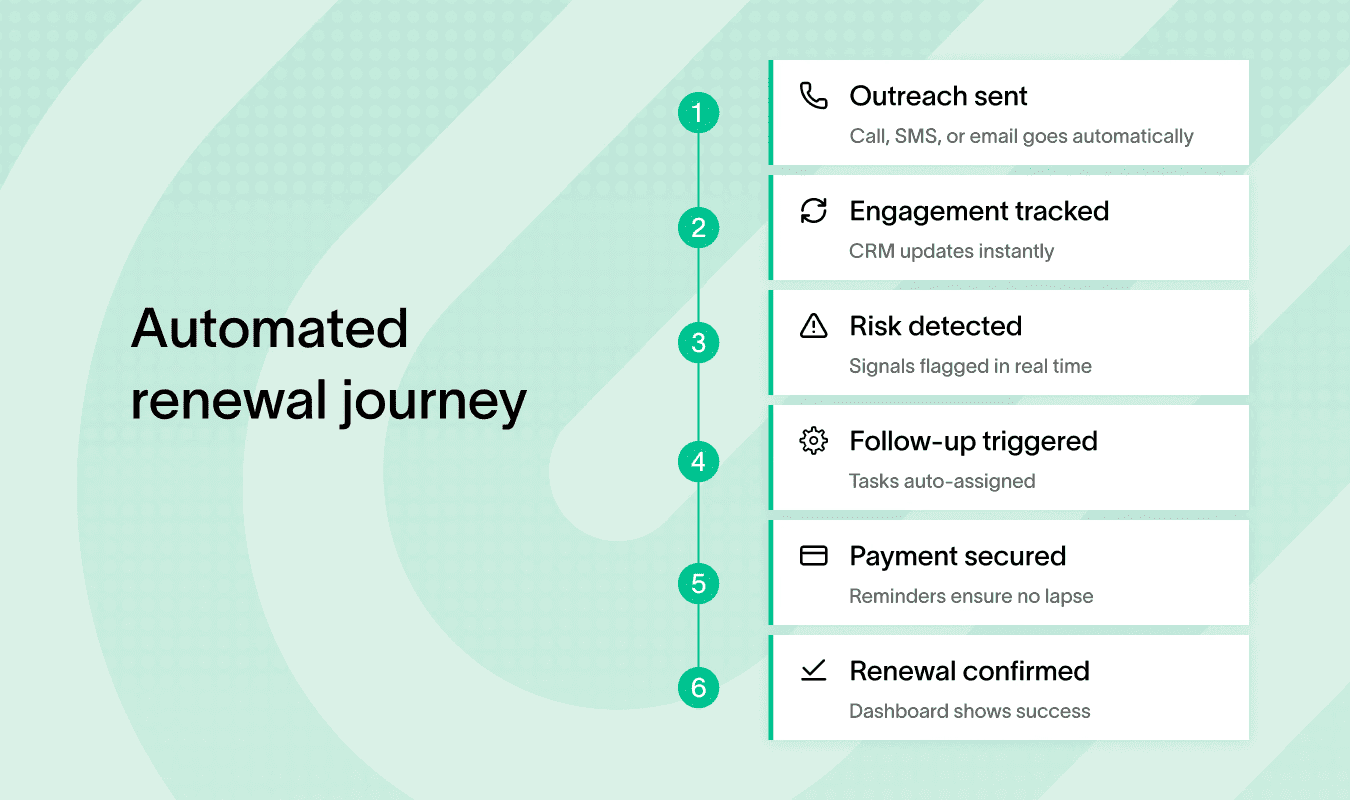
Missed renewals quietly drain revenue for agencies managing hundreds of group policies. Automated renewal workflows trigger sequenced client outreach, emails, reminders, and document requests, based on expiration dates pulled directly from the AMS. This eliminates the manual calendar-chasing that consumes producer time. The limitation: personalization quality drops if client data in the AMS is stale, so clean, current client data has to come first.
3. Certificate of Insurance (COI) Issuance at Scale
COI requests are among the highest-volume, most repetitive tasks in any commercial lines agency, and among the most error-prone when handled manually. Automating COI issuance means AI reads the underlying policy, populates the ACORD 25 form, validates coverage details, and delivers the certificate without staff intervention. Teams processing 50+ COIs daily see the clearest ROI. The tradeoff: non-standard certificate holder requirements or manuscript endorsements still require manual review.
4. New Client Onboarding & Digital Data Intake
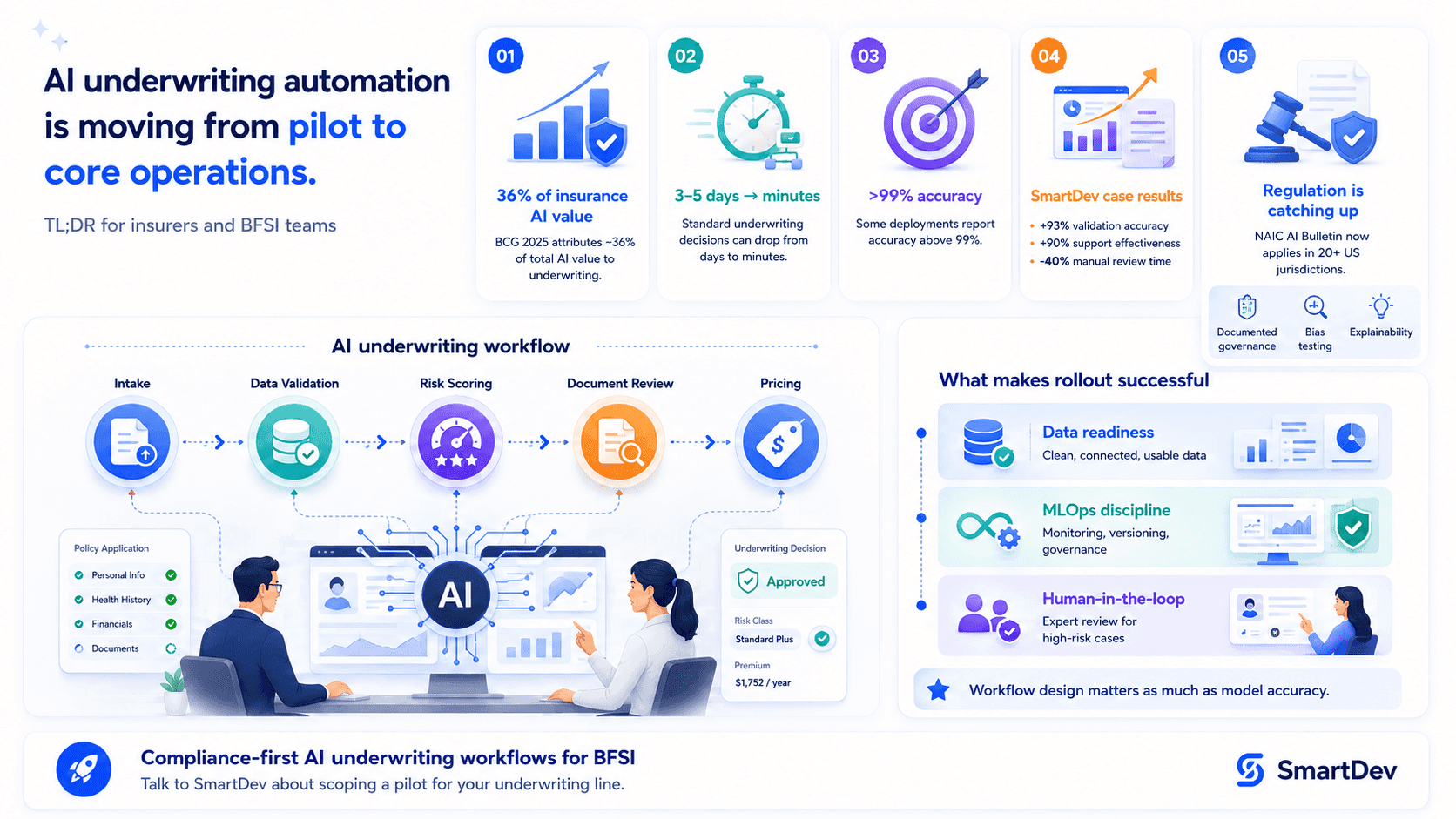
Paper applications and email-based data collection create bottlenecks that delay policy binding and frustrate new clients before the relationship even starts. Replacing manual intake with automated digital journeys, smart forms that adapt based on coverage type, reduces incomplete submissions and accelerates time-to-quote. This workflow is especially high-impact for agencies onboarding 20+ new clients monthly. The tradeoff: building well-designed intake flows requires upfront configuration investment.
5. Manual Data Entry Elimination Across Policy Administration
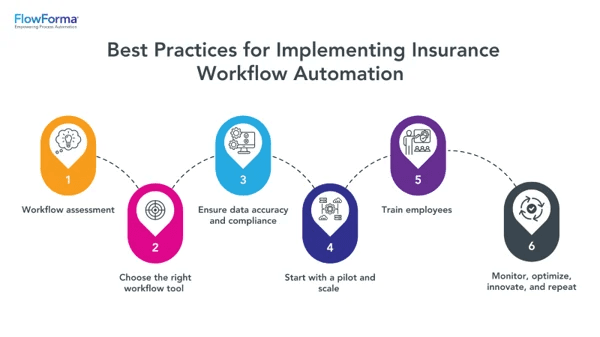
Duplicate data entry across AMS, carrier portals, and spreadsheets is one of the most cited pain points crushing insurance back-office productivity. Insurance workflow automation addresses this by using RPA and API integrations to sync policy data across systems in real time, eliminating re-keying entirely. Carriers and MGAs with fragmented legacy tech stacks benefit most. The key limitation: deep integrations require IT involvement and may face resistance from carriers with closed portal ecosystems.
6. Client Communication & Touchpoint Automation Post-Bind
Most agencies go silent after binding, a missed opportunity that drives churn. Automating post-bind client interactions means scheduling check-in emails, coverage review invitations, and life-event prompts based on policy milestones rather than producer memory. This workflow is the highest-leverage retention tool for personal lines and small commercial agencies. The tradeoff: automated messages must be carefully templated to avoid feeling generic, which requires ongoing content maintenance to stay effective.
How FNOL, Underwriting, and Policy Renewal Automation Work in Practice
Three workflows dominate every automation conversation in insurance right now. The problem is that most agency owners and operations leaders picture them as one tangled system, which is exactly why they never touch any of them. The reality is simpler: FNOL intake, underwriting scoring, and policy renewal orchestration are three discrete, independently deployable modules. You can automate renewals without touching underwriting. You can stand up automated FNOL intake without rebuilding your claims stack. Each one has its own trigger logic, its own data sources, and its own ROI timeline.
The core synthesis claim here is this: independent agencies under-adopt payment automation not because the technology is unavailable or unaffordable, but because they are caught in a social proof trap. When every peer agency runs the same manual check-chasing and reconciliation grind, shared suffering gets misread as proof that no better option exists, when in reality it only proves no one in that peer group has looked outside it. Carriers and MGAs have already solved the same problems, and the tools are available to agencies today without requiring a system replacement.
1. FNOL Automation – AI-Driven Intake That Routes Claims in Minutes, Not Days

FNOL automation uses AI and OCR to ingest claims documents, extract incident details, validate data, and route the claim to the right adjuster automatically, replacing a manual intake process that previously took hours with one that completes in minutes. Modern FNOL platforms integrate directly with existing claims management systems, so the technology stacks on top of current infrastructure rather than requiring a full replacement. The real tradeoff is setup complexity. Connecting AI-driven intake to a legacy claims system still requires IT involvement, and agencies with low monthly claim volume may find the configuration cost outweighs the time recovered.
2. Underwriting Automation – ML-Powered Risk Scoring That Replaces Manual Submission Review

Underwriting automation gathers risk data from third-party sources, runs credit and loss-history scoring models, and returns a risk assessment without a human touching the submission file. The practical result is quote turnaround that drops from days to minutes for standard-risk accounts. One critical and often-skipped detail: the NAIC and several state regulators require that ML-based adverse underwriting decisions be explainable in plain language to the applicant. Agencies and MGAs adopting automated scoring tools need to confirm that the model they deploy can produce that explanation on demand. Automated scoring is most beneficial when submission volume is high enough that manual review creates a visible queue backlog; for a low-volume book, the configuration overhead can exceed the time saved.
Policy Issuance & Renewals Automation, Trigger-Based Workflow Orchestration for MGAs and Carriers. Policy renewal automation fires a trigger 45 days before expiration, generates the renewal document, and delivers it to the policyholder without agent involvement.
3. Policy Renewal Automation – Trigger-Based Workflow Orchestration for MGAs and Carriers
Policy renewal automation moves beyond reminder emails by triggering multi-step workflows, pulling loss runs, generating updated quotes, routing to underwriting review, and tracking SLA deadlines, all based on configurable renewal date triggers. This approach is best suited for MGAs and wholesalers managing large books where manual renewal chasing creates retention leakage. The tradeoff is implementation complexity: mapping existing renewal rules into workflow logic requires significant upfront process documentation and stakeholder alignment.
How Claims Processing and Billing Automation Work – Including the Payment Workflows Most Agencies Overlook
Paper checks are not a nostalgic quirk in independent agency operations. They are an active cost center, and most agency owners have simply stopped noticing.
The automation conversation in insurance almost always starts with claims. That instinct is reasonable: claims processing is visible, emotionally charged, and directly tied to policyholder satisfaction. Automation compresses the claims cycle from intake to settlement by handling FNOL intake, status updates, payment triggers, and settlement documentation through straight-through processing pipelines, reducing what previously took days to minutes for straightforward claims. The problem is that most independent agencies treat this as the only automation conversation worth having, and they wait for their carrier to lead it.
The billing and payment side sits in a different category entirely. It does not wait on a carrier or sit behind a 14-month IT implementation, and it is costing more daily staff hours than any claims workflow most independent agencies will ever touch. The mistake is one of category: agency owners lump premium collection in with carrier-level overhauls, when in reality billing and reconciliation automation is a targeted fix that runs on top of the systems you already have, without replacing any of them.
1. ePayPolicy – Best End-to-End Payment Workflow Automation for Insurance Agencies

Billing automation answers a different question: how does premium collection, remittance, commission reconciliation, and return premium processing stop consuming hours of back-office staff time every week? An agency still running monthly check-reconciliation spreadsheets is facing a workflow classification error, and the agencies we work with at ePayPolicy consistently identify chasing checks and manual payment processing as the single largest drain on staff hours they had stopped measuring.
Manual commission reconciliation is particularly costly because discrepancies compound quietly. An agency cross-referencing carrier statements against AMS records by hand will miss shortfalls that a real-time automated match would surface immediately. Return premium processing is similarly stubborn: mid-term cancellations trigger refund calculations that most agencies still complete manually, one transaction at a time.
ePayPolicy addresses this at the point where the bleed is worst. Agencies can begin accepting secure online payments and go live accepting digital payments quickly, without a multi-month implementation or changes to core infrastructure. For agencies that regularly issue high volumes of outbound checks to agents or partners, Network Payables eliminates paper-check printing and mailing entirely, replacing it with a managed digital payables workflow. For agencies whose clients have predictable recurring invoices, AutoPay is particularly effective: clients set up their account once to automatically pay due invoices as soon as they are posted from the agency’s management system, with no manual action required per invoice.
CheckMate targets the check-reconciliation problem directly, and Finance Connect converts inbound paper checks to digital, routed and reconciled in the dashboard. Agencies with a management-system integration in place can track transactions in real time and surface discrepancies before they compound, rather than discovering shortfalls weeks later during a manual statement review.
Key takeaway: Billing and premium collection automation is not a future-state initiative. For most independent agencies, it is the highest-leverage operational fix available today, and it does not require waiting on a carrier, a core system replacement, or a lengthy IT queue.
2. Straight-Through Processing (STP): Automating Claims from First Notice to Payment Disbursement
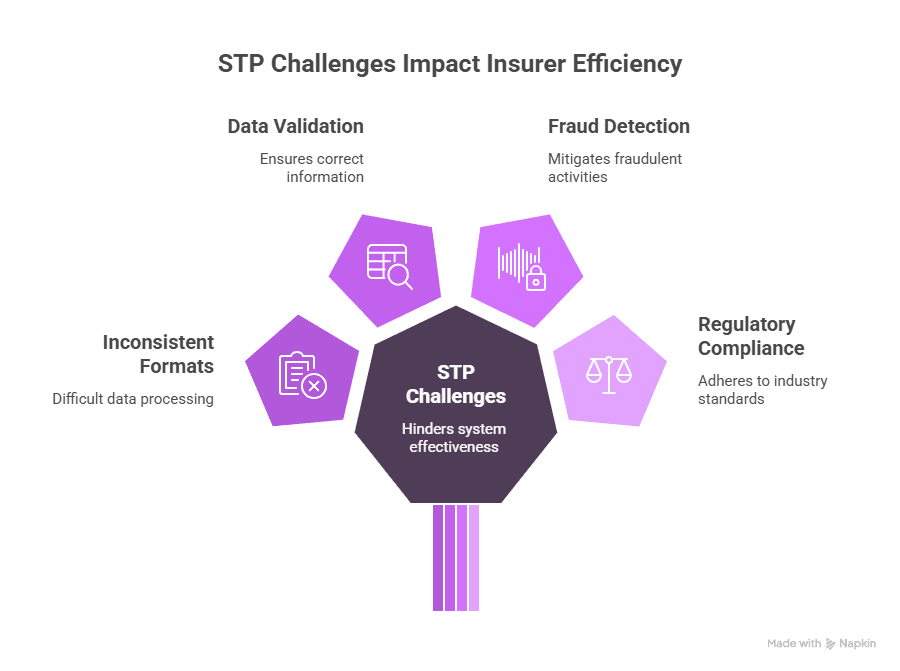
Straight-through processing eliminates every manual touchpoint between claim intake and payment issuance by routing low-complexity claims through automated decisioning rules without adjuster intervention. This insurance workflow automation approach is ideal for high-volume, low-severity claims like auto glass or minor property damage. The critical limitation: STP requires clean, structured data at intake, agencies with inconsistent FNOL data quality will see exception rates spike and negate efficiency gains.
3. Return Premium Transaction Automation – The Manual Workflow Most P&C Agencies Still Haven’t Fixed
Return premium processing, refunding unearned premium after mid-term cancellations or endorsements, remains stubbornly manual at most agencies despite broader automation investments. Automating this workflow means triggering refund calculations, carrier notifications, and client disbursements from a single policy change event. It’s the right priority for agencies with high policy churn or commercial lines books. The real tradeoff: automation logic must account for pro-rata versus short-rate cancellation rules, which vary by carrier and state.
Related Reading
- Insurance Agency Automation
- Insurance Automation Tools
- Insurance Premium Payment Automation
- Insurance Premium Collection Process
- Insurance Agency Efficiency
Key Benefits of Insurance Workflow Automation – Beyond the Obvious Time Savings
The key benefits of insurance workflow automation are concrete and measurable: faster cycle times, fewer errors, lower operational costs, and a policyholder experience that no longer depends on a staff member picking up the phone. But most independent agency owners only hear the speed argument, which is the weakest version of the case.
1. Automated Fraud Detection That Learns From Every Claim
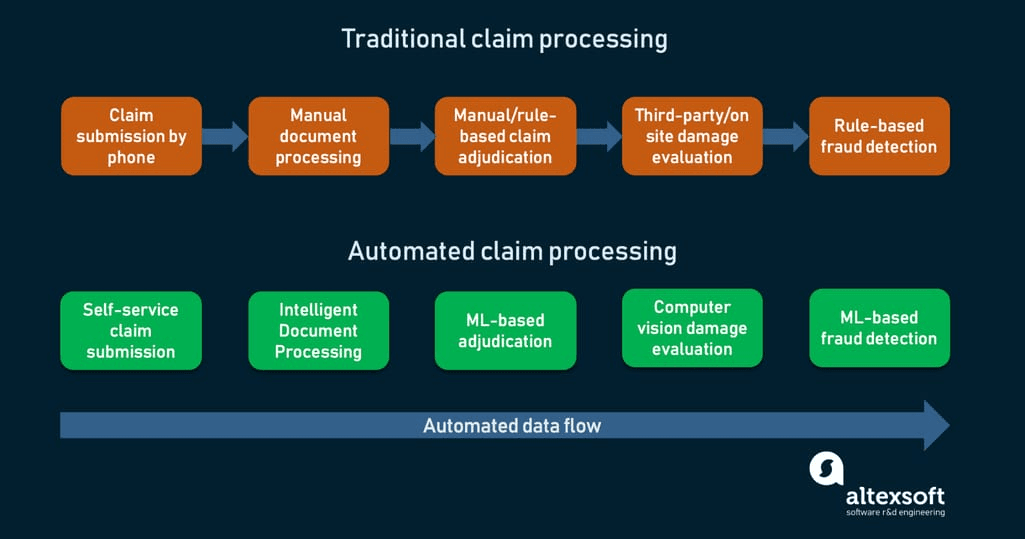
Insurance workflow automation doesn’t just speed up claims, it builds a continuously improving fraud-detection layer. AI models trained on historical claim patterns flag anomalies human adjusters routinely miss. This is the right investment for mid-to-large carriers processing high claim volumes where leakage is significant. The real tradeoff: model accuracy depends heavily on data quality and volume, making it less effective for niche or low-frequency lines.
2. Straight-Through Processing for Low-Complexity Claims
Straight-through processing (STP) routes simple, low-risk claims from first notice of loss to payment without human touchpoints. For personal auto or homeowners carriers, STP can resolve 40–60% of claims automatically, freeing adjusters for complex cases. It’s the highest-ROI entry point for insurers new to workflow automation. The limitation: STP thresholds require careful calibration, set them too broadly and you expose the carrier to unchecked payouts.
3. Intelligent Document Extraction Across Unstructured Formats
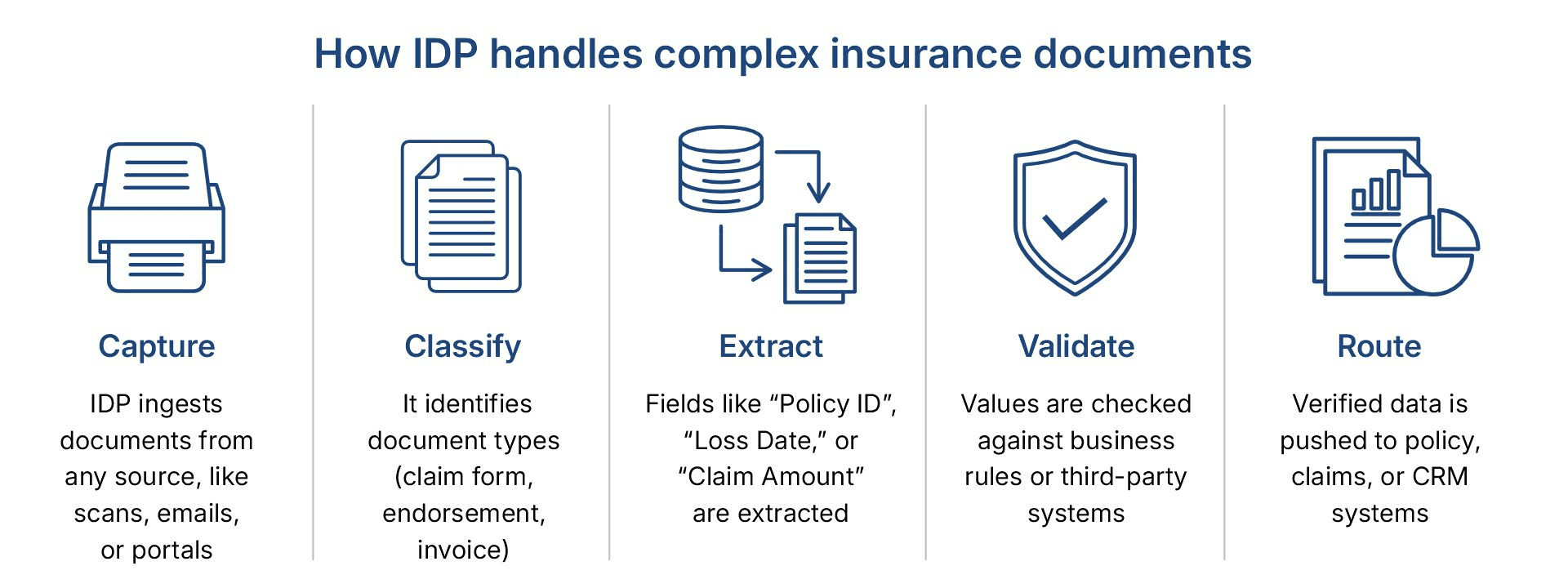
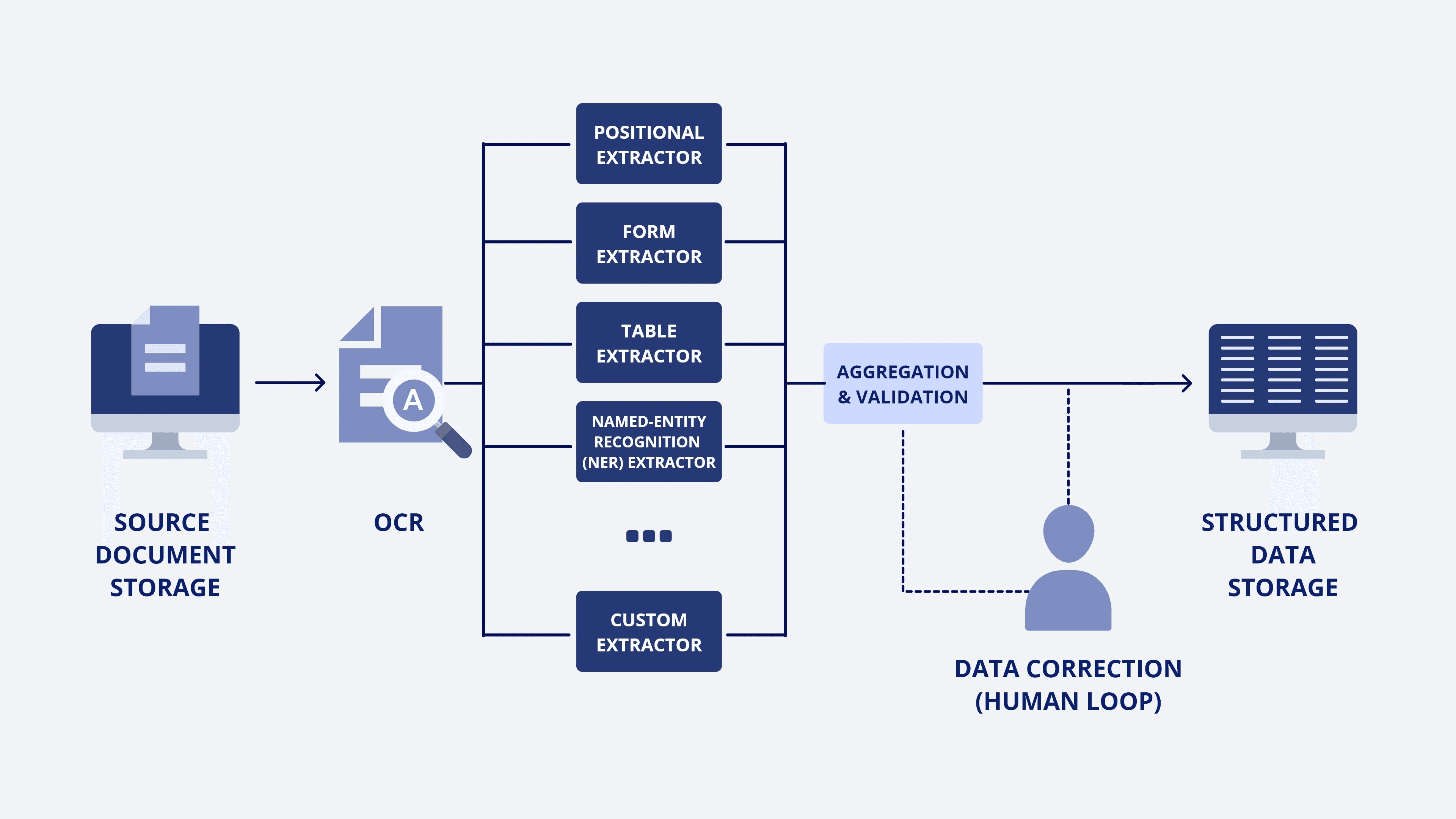
Insurance operations drown in PDFs, handwritten forms, medical records, and repair invoices. Automated document extraction using OCR and NLP pulls structured data from unstructured sources, eliminating manual re-keying and the transcription errors that follow. This benefit compounds across underwriting, claims, and compliance teams simultaneously. The tradeoff is upfront training time, models must be tuned to each document type, and edge-case formats still require human review queues.
4. Continuous Compliance Monitoring Built Into Every Workflow Step
Regulatory requirements in insurance change frequently across jurisdictions, and manual compliance checks create audit gaps. Workflow automation embeds compliance rules directly into process steps, flagging missing disclosures, incorrect policy language, or missed filing deadlines in real time rather than during an audit afterward. This is especially critical for carriers operating across multiple states. The limitation: compliance rule libraries require ongoing legal maintenance as regulations evolve.
5. Underwriting Acceleration Through Automated Risk Data Aggregation
Life and commercial underwriters spend disproportionate time gathering third-party data, credit scores, MVRs, medical records, property databases. Insurance workflow automation pulls these sources simultaneously at submission, presenting underwriters with a pre-populated risk profile rather than a blank intake form. This compresses underwriting cycle times from days to hours. The tradeoff: integrating disparate external data vendors requires robust API management and introduces dependency risk if a data source goes offline.
6. Policyholder Self-Service Portals That Reduce Inbound Call Volume
Workflow automation extends beyond back-office operations, self-service portals let policyholders file claims, update coverage, and retrieve documents without agent involvement. This directly reduces inbound call center volume, a measurable operational cost. For personal lines carriers with high policyholder-to-staff ratios, this benefit rivals back-office efficiency gains. The real limitation is adoption: older policyholder demographics often require parallel phone support, meaning carriers can’t fully retire traditional service channels.
Compliance and Auditing Automation: the Risk-Reduction Layer Independent Agencies Often Skip
Audit time has a way of revealing exactly how much invisible work your back-office processes were never doing. For independent agencies running lean teams, compliance documentation tends to pile up by accident rather than by design, and that gap only becomes visible when a regulator asks for records you have to reconstruct from memory.

What an Automated Audit Trail Actually Captures, and Why Manual Logging Cannot Replicate It
Compliance and auditing automation works by capturing a timestamped, tamper-evident record of every transaction, document action, and account movement at the moment it occurs, not hours or days later when someone remembers to log it.
Key takeaway: 58.2% of statutory financial report filings examined contained compliance or filing errors in the Notes section, the predictable output of documentation processes never designed to capture data in real time.
Those are not errors of intent. They are the predictable output of documentation processes that were never designed to capture data in real time. Manual logging introduces a lag, and in that lag, details drift, get omitted, or get reconstructed inaccurately.
That lag compounds a second problem agencies we work with feel acutely: days sales outstanding on premium receivables creeps upward when payment status lives in someone’s head or a spreadsheet that hasn’t been reconciled yet. When collection timing is opaque, float risk grows and cash flow becomes harder to forecast quarter over quarter. An automated, real-time audit trail fixes this for regulators and for your own financial visibility.
Reconciliation Automation as a Built-in Compliance Record, the Audit Trail That Writes Itself
Most independent agencies absorb the pain of manual payment reconciliation without realizing it is also a compliance liability. Every time a staff member manually cross-references a premium payment against a bank statement and an AMS entry, they are also failing to generate the kind of defensible, timestamped record that regulators expect to see. As FBSPL noted in 2025, automation enables real-time tracking, centralized documentation, and faster audit readiness, reducing both risk and operational effort for compliance teams.
ePayPolicy’s connected accounting layer, including Finance Connect and Payables Connect, captures every transaction with a timestamped, rule-enforced record at the moment it occurs, converting reconciliation from a manual compliance task into an automated audit trail that is ready for regulatory review without additional preparation. This is most beneficial when the agency already has a management-system integration in place, because Finance Connect can write payment data directly back into the AMS, eliminating the manual re-entry step where errors and omissions typically enter the record.
For agencies that issue high volumes of outbound payments to agents or partners, Network Payables eliminates paper-check printing and mailing, replacing it with a documented digital disbursement record that is captured and centralized automatically. For clients with predictable recurring invoices, AutoPay allows clients to set up their account once to automatically pay due invoices as soon as they are posted from the agency’s management system, with no manual action required per invoice, directly reducing days sales outstanding on premium receivables so float risk shrinks and cash flow becomes more predictable quarter over quarter. Every AutoPay transaction writes its own timestamped record, so the compliance trail is a byproduct of the payment itself.
How to Implement Insurance Workflow Automation Without a Big IT Project
Choosing where to start is the decision most agency owners never actually make. They know automation would help, they’ve seen the demos, and then they open a new browser tab and go back to reconciling payments by hand because the implementation question feels too big to answer on a Tuesday afternoon.
For independent agencies, the highest-leverage entry point into automation is the payment-to-reconciliation arc, because that single workflow contains the most compressible manual touchpoints and the most invisible financial leakage, so a narrow, surgical fix to billing and collection outperforms a broad IT initiative in both speed of recovery and measurable revenue impact. That reframe changes which question you’re actually trying to answer.

Audit by Time Cost First, Not by Technology Readiness
The right starting point isn’t the workflow that looks most automatable. It’s the workflow that is consuming the most staff hours right now. Manual payment reconciliation can consume significant back-office time each week, as staff cross-reference bank records against AMS entries line by line. That is time your team is not spending on renewals, new business, or client calls.
One pressure point that often goes unspoken: broker platforms and MGA operations that are weeks away from a go-to-market launch cannot afford a prolonged IT buildout. When your back-office team is already stretched across a high volume of retail agency partners, adding a months-long implementation project to the calendar is a blocker. The practical answer is to start at the receivables layer, where a targeted fix delivers the fastest measurable relief. What most teams report, once they make the switch, is that automated reconciliation replaces a time-intensive, error-prone process with a system that automatically matches records across sources, converting an unavoidable burden into a solved tooling problem.
For agencies still collecting by paper check or phone, the first move is digitizing inbound receivables. ePayPolicy’s online Credit Card & ACH payment capability is most beneficial precisely at that moment, when the agency wants to eliminate paper-check intake quickly, without a lengthy implementation runway, and start compressing the manual touchpoints in the payment-to-reconciliation arc immediately.
Why Insurance-Native Tools Beat Generic Automation Software for Compliance-Sensitive Processes
Generic workflow software treats a payment like any other data event. Insurance payments are not that. They involve trust accounting rules, premium financing structures, and carrier remittance requirements that a general-purpose tool was never trained to handle. The cost of getting this wrong is not trivial: insurance claim processing already takes weeks to months in the best circumstances, and any errors or resubmissions compound that delay significantly, so automation mistakes inside a compliance-sensitive billing workflow carry real financial and reputational consequences.
Across the market, automation solutions built natively into the agency management system reduce errors and manual reconciliation effort more reliably than bolt-on tools, because they remove the manual step of moving data between the payment and the policy record. Insurance-built tools handle compliance as part of the everyday workflow rather than as a separate audit step scheduled later. Independent agencies that have switched from generic tools to insurance-native billing platforms commonly report eliminating the most time-intensive manual reconciliation steps, an outcome that is difficult to achieve with general-purpose automation software, which was not designed to handle trust accounting rules or carrier remittance structures natively.
That distinction matters most when your operation handles a high volume of outbound disbursements alongside inbound premiums. ePayPolicy’s Network Payables and Payables Connect features address exactly that side of the ledger: they are most beneficial when the business regularly issues high volumes of outbound checks to agents or partners and wants to eliminate paper-check printing and mailing, which is precisely where back-office teams working with large retail agency networks tend to drown in manual reconciliation effort.
On the inbound side, the configuration that unlocks the greatest efficiency is straightforward: when a management-system integration is already in place and clients have predictable recurring invoices, ePayPolicy’s AutoPay feature can be activated directly inside the existing AMS workflow. Clients set up their account once to automatically pay due invoices as soon as they are posted from the agency’s management system, no manual action required per invoice. The result is a streamlined premium collection and disbursement process across a high volume of retail agency partners that does not require adding headcount or tolerating reconciliation backlogs to sustain it.
Related Reading
- Payment Processing For Insurance Companies
- Insurance Payment Processing Companies
- Insurance Remittance Processing Systems
Next steps
If your agency is still absorbing the daily cost of chasing checks, reconciling transactions by hand, and waiting on paper payments that never seem to arrive on time, the path forward starts with recognizing that this is a gap in your tools rather than something inherent to the industry. The gap between taking a payment and reconciling it is fixable, and it does not require touching your core AMS to fix it. Start with our insurance billing software.
The social proof trap explored earlier in this post means that most agency owners file billing automation in the same mental category as FNOL intake overhauls, assuming the implementation complexity is comparable. It is not. Billing and reconciliation automation is categorically closer to a targeted workflow fix, one that can go live in days on top of existing systems. That distinction matters because it changes the decision in front of you from “do we have the IT bandwidth for this” to “when do we start.”
Start with insurance billing software built specifically for independent agencies. Connect your existing AMS, enroll policyholders in digital payments, and let the reconciliation layer run automatically from the first billing cycle forward.
Frequently Asked Questions
Do I have to replace my agency management system to start automating workflows?
No. Insurance workflow automation is specifically designed to run on top of your existing systems without touching core infrastructure. The scope of the fix matches the scope of the problem, a targeted automation touches one workflow and can go live within days.
Which workflow should an independent agency automate first?
For most independent agencies, billing and premium collection is the best starting point, ahead of claims. It has high daily friction, low technical complexity, and is fast to fix without waiting on a carrier or a lengthy IT queue.
How does AI actually fit into insurance workflow automation, what does it do?
AI and OCR handle one job extremely well: reading documents so humans don’t have to. In practice, this means ingesting claims documents or payment records, extracting relevant details, validating data, and routing files automatically, replacing steps that previously took hours with ones that complete in minutes.
How does underwriting automation actually work, and when does it make sense to use it?
Underwriting automation gathers risk data from third-party sources, runs credit and loss-history scoring models, and returns a risk assessment without a human touching the submission file, dropping quote turnaround from days to minutes for standard-risk accounts. It makes the most sense when submission volume is high enough that manual review creates a visible queue backlog; for a low-volume book, the configuration overhead can exceed the time saved. One important compliance note: the NAIC and several state regulators require that ML-based adverse underwriting decisions be explainable in plain language to the applicant, so any automated scoring tool you adopt needs to produce that explanation on demand.
How does policy renewal automation work, and what does the agency actually have to set up?
Renewal automation fires an expiration-based trigger automatically, runs outreach sequences without manual initiation, and generates and delivers the policy document on its own schedule. Most agency management systems support expiration-based triggers natively, so the lift is configuration rather than deep integration, making this one of the faster wins available, especially for agencies with a management-system integration already in place and clients on predictable recurring invoices.