Growing MGAs, carriers and agencies that are looking for both scale and speed understand that an online payment page is more than just a “Pay Now” button and checkout experience. It’s one of the most important service experiences an insurance company can offer, and critical to both new and renewal business as well as an efficient accounting back office.
In 2026, the difference between a “generic” payment processor and an “insurance-native” solution isn’t just about the interface. It’s about how these systems are designed to fit within your insurance-specific workflows.
This guide provides a framework to evaluate payment solutions through the lens of finance efficiency, data integrity, and policyholder trust.
Step 1: Evaluate Workflow Fit (Specific vs. Generic)
Most finance teams start by looking at big-box providers like Stripe or their existing banking relationships. Well-known and reliable, they often lack the insurance-specific integrations or niche workflows required to handle efficient premium collection at scale. The real frustration with these systems sometimes doesn’t manifest until months after go-live, where insureds enjoy an efficient checkout, but back office work features manual workarounds and unexpected efficiency gaps.
The Pitfalls of “Generic” Payment Pages
- Data Disconnect: A generic page might capture a dollar amount but fail to require a Policy Number, Binder Number, or Effective Date.
- Fee Friction: Generic processors often force the merchant to absorb the credit card and ACH fees. In insurance, where premiums can be five or six figures, that “small” percentage becomes a massive overhead cost.
- The “Orphan Payment” Problem: Without specific data fields, finance teams spend hours playing detective, trying to match specific payments to multiple policies under the same payer name.
- Lack of System Integration: A too-basic or altogether absent connection to agency management systems or carrier accounting systems often requires more headcount for the manual re-entry of sensitive payment or customer information.
The Insurance-Native Advantage
Solutions like ePayPolicy are built specifically for the industry. They understand the nuances of things like agency bill, direct bill, commissions reconciliation, chargebacks, etc. and allow for more flexible options when it comes to payment fees, preserving your margins. Pre-built existing and custom API integrations ensure payments data travels in real-time with the payment, through connected systems, eliminating manual work and dramatically reducing risk.
Step 2: Reconciliation Depth
Reconciliation is where finance teams often spend countless hours of time. A payment page should do more than just drop money into your bank account; it should talk to your Agency Management System (AMS) or Core System.
The “Reconciliation Efficiency” Formula
(Payments X Time X Rate) + Error Costs = Your Monthly Payments Cost
Sometimes the best way to explain a formula is to show it in action. If your team processes 500 payments a month, and each takes 10 minutes to reconcile at a $35/hr labor rate:
- Labor: $2,916
- Error Corrections (avg. 2% error rate): $450
- Total Monthly Cost: $3,366
An insurance-native payment page reduces this to near-zero by automating the data entry directly into your AMS.
Evaluation Tip: Ask the provider if they have “out-of-the-box” integrations with systems like Vertafore, Applied, or HawkSoft. If the answer is “We have an open API,” translate that to: “Your IT team will need to build this themselves.”
Step 3: Compliance and Security (Beyond the Basics)
In 2026, being “PCI Compliant” is the bare minimum. With the rise of deepfake-enabled fraud and sophisticated phishing, look for providers that offer:
- PCI Level 1 Security: The highest grade of security available.
- Tokenization: Ensuring sensitive card or bank data never actually touches your servers.
- Account Verification: For ACH/A2A payments, does the system verify account ownership in real-time to prevent NSF (Non-Sufficient Funds) returns?
Step 4: The User Experience (UX)
If the page is hard to use, the policyholder might delay payment or default to 1972’s favorite payment method: Mailing a paper check. The insurance industry is steeped in check payments, resulting in delayed policy binding, suppressed cash flow and unnecessary late payment policy cancellations. All because “the check’s in the mail.”
Look for these features in a payment page to reduce friction:
- Mobile-Friendly Design: An increasing % of policyholders in 2026 prefer paying via smartphone.
- Payment Links: The ability to text or email a “one-click” link directly to the client.
- Guest Checkout: Don’t force a policyholder to create a username and password just to pay you money.
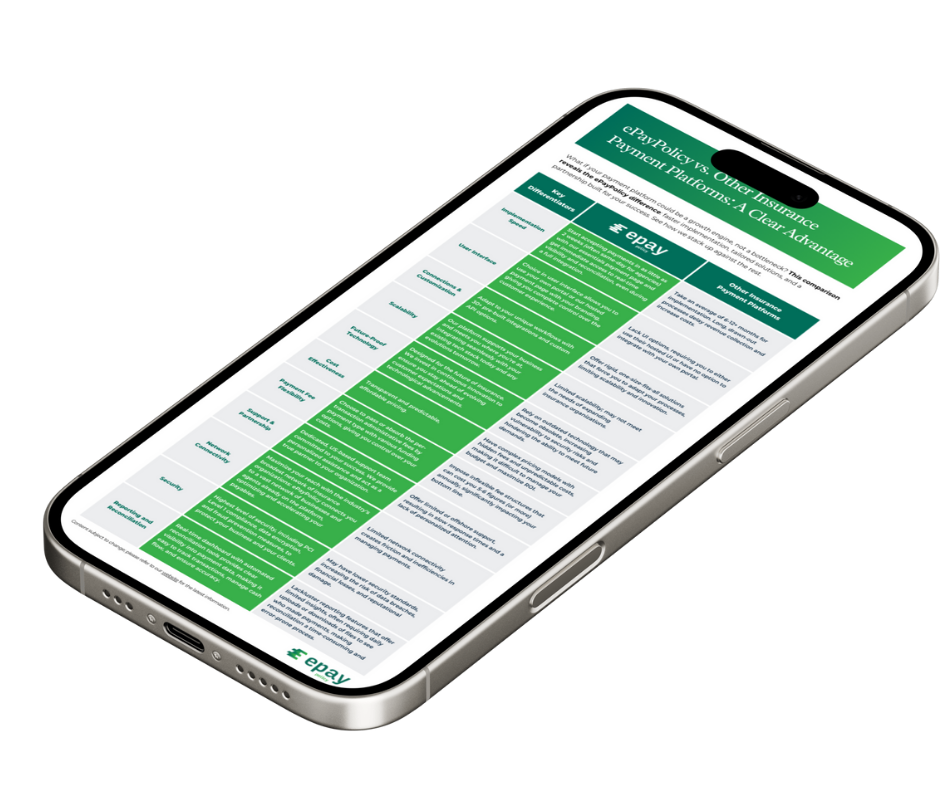
Decision Scorecard: Generic vs. Insurance-Native
|
Feature |
Generic (Stripe/PayPal) |
Insurance-Native (ePayPolicy) |
|
Setup Speed |
Fast (without integration*) |
Fast |
|
Industry Data Fields |
Limited / Custom Build |
Pre-configured (Policy #, etc.) |
|
Fee Structure |
Merchant-Absorbed |
Flexible (Pass-through options) |
|
AMS Integration |
Rare / Custom API |
Native (Vertafore, Applied, etc.) |
|
Security |
Excellent |
Excellent + Industry Compliance |
|
Best For |
Retail / Simple E-commerce |
Carriers, MGAs, and Agencies |
Conclusion: What Do You Really Need?
While big-box providers offer incredible global reach and Guidewire-level enterprise suites offer total core-system dominance, most MGAs and carriers find their “just right” fit in a dedicated insurance payment platform.
At ePayPolicy, we focus on ROI delivered with back-office wins. We believe your payment page should be a tool that accelerates your cash flow while simultaneously cleaning up your ledger. By choosing a partner that understands that a premium isn’t just a transaction, you’re not just buying a payment page; you’re buying back your finance and accounting team’s time.
Who’s ePayPolicy? We help over 12,000 insurance companies – agencies, MGAs, carriers and more – collect premium payments online. You’ll spend less time chasing down checks and paying payment fees from a generic solution, and more time growing your book of business. We make agency bill as easy as direct bill, and your insureds will love the convenience of paying online. Learn more: epaypolicy.com